
Why LED Displays Are Replacing Traditional Projection at Corporate Events
Projection dims the moment you turn the lights on, and corporate events are not held in the dark. Why LED has taken over the conference stage, and the cases where a projector is still the right call.
 Kudos AV · Production insights
In this article
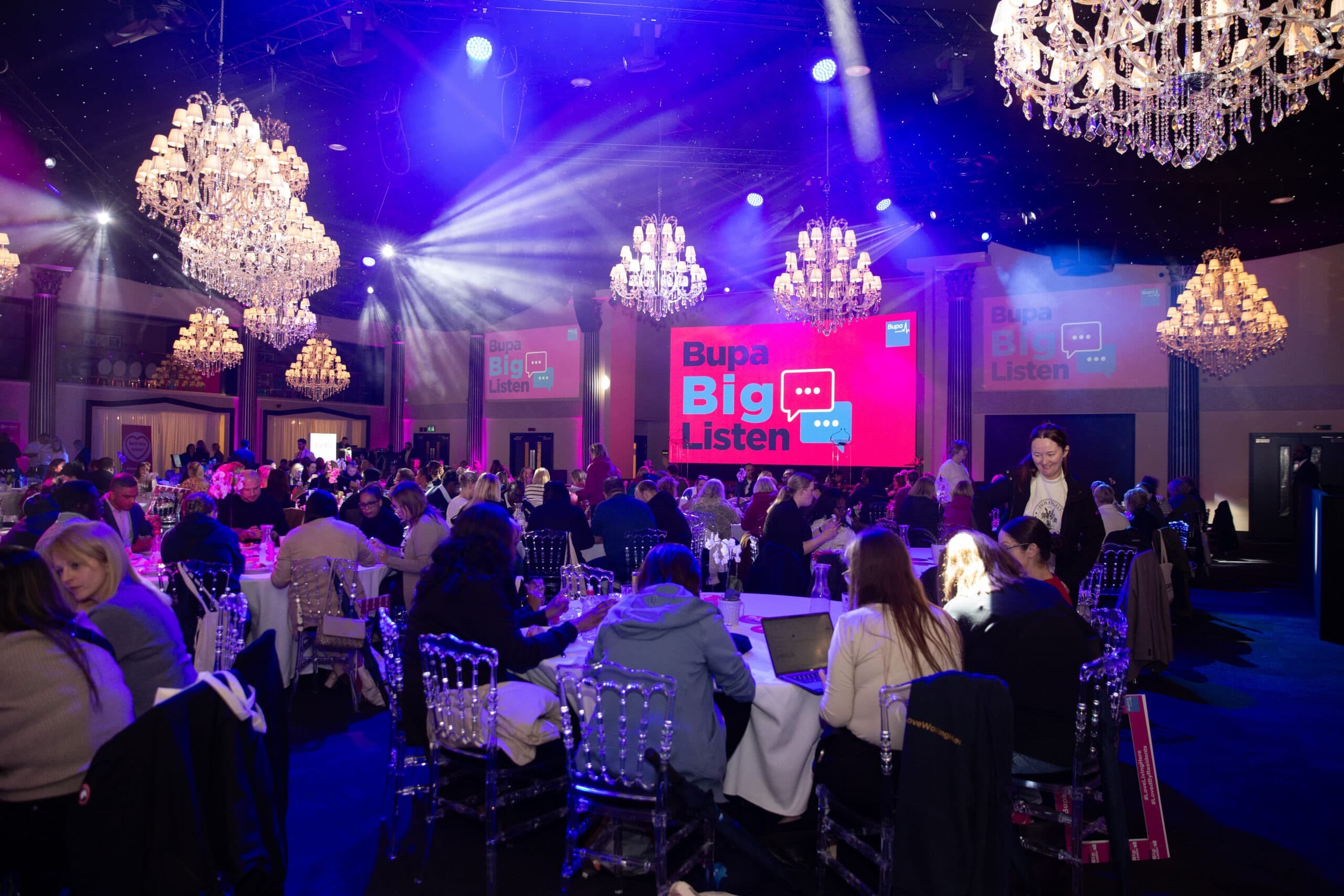
Have you ever sat in a conference room squinting at a washed out slide? The content was fine. The room lights were on, the projector was doing its best, and the message arrived grey.
That is the whole argument in one image. Corporate audiences expect visuals that stay bright and readable for the length of a day, and they are not sitting in the dark to get them. Businesses looking for LED wall events London solutions are moving across for a simple reason: an LED panel makes its own light, so the room no longer competes with the picture.
Kudos AV supplies LED walls and video production alongside staging, lighting, sound and print for corporate events across the UK, with one team responsible for the lot. Here is what actually changes when you swap projection for LED, and where projection still wins.
Key takeaways
- LED displays hold their brightness in a lit room, which is where corporate events are actually held.
- Screens can be sized and shaped to the stage, rather than the stage being planned around a throw distance.
- LED photographs cleanly, which matters as soon as an event is filmed or streamed.
- Nobody walks through an LED image, so a presenter can use the full stage.
- Projection still wins on very large coverage, on mapped surfaces, and on budget.
Why is traditional projection losing ground?
Projectors have carried conferences and business meetings for years, and in the right room they still do a good job. What has changed is the room and the content.
A projector throws light at a surface, so every other light in the venue is working against it. Turn up the house lights so people can see their notes, or open a blind, and the image loses contrast. Blacks turn grey first, and the slide that looked strong on a laptop reads flat from row fifteen.
There is a staging problem too. The beam has to travel from the projector to the screen, so anything in the path is in the picture. Presenters learn to walk around their own content, which is a strange thing to ask of someone who is meant to be commanding a stage.
Meanwhile the content got heavier. A conference now runs video, live demonstrations, camera feeds and branded motion graphics rather than a deck of static slides, and it expects all of it to hold up for eight hours.

What are the advantages of LED screens over projectors?
The advantages of LED screens over projectors come down to four things that show up on the day.
It stays readable with the lights on
An LED panel emits light rather than reflecting it, so ambient light costs you far less. The practical effect is that the lighting designer stops negotiating with the screen: delegates can see their table, the presenter can be lit properly, and the content still reads from the back of the room.
The screen fits the stage
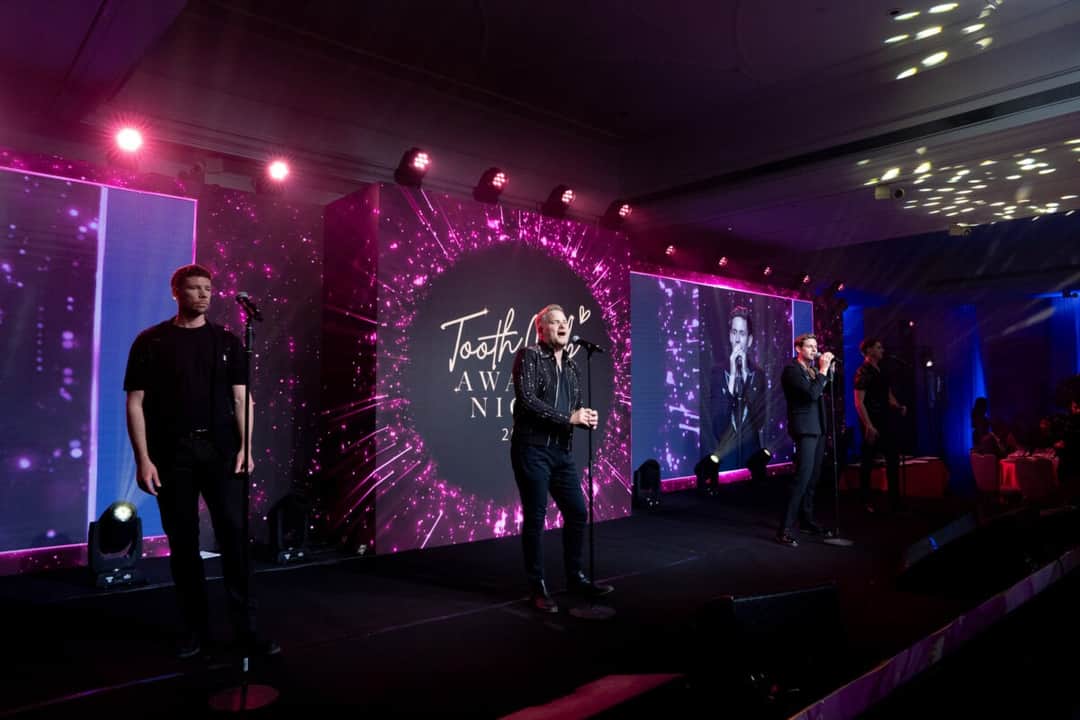
LED is built from panels, so the display is whatever shape you draw. Stage-width backdrops, columns either side of a set, a ribbon above the stage, a curve around a product. The screen becomes part of the scenic design instead of a rectangle the set has to accommodate.
Content holds up close
Fine pixel pitches keep text sharp for the people in the front rows, which matters for data, small type and anything a delegate is expected to read rather than admire. Choosing that pitch against the seating plan is part of the design.
It behaves on camera
Anything filmed or streamed is a second audience. LED gives cameras a bright, even background, and the wall is set to suit the frame rate so it does not band or flicker on the recording. If the event is being live streamed, this is usually the deciding argument.
LED displays vs traditional projection: what is the difference?
Comparing LED displays and projectors, the differences that matter are brightness, sizing, image quality and how each behaves in a real room.
| Feature | LED displays | Traditional projection |
|---|---|---|
| Brightness | Holds up with the room lights on | Needs the light kept off it |
| Screen size | Panels build to any size or shape | Limited by throw distance and surface |
| Image quality | Consistent contrast through the day | Depends on the projector and the ambient light |
| Presenters | Nobody casts a shadow on it | The beam path has to stay clear |
| On camera | Clean background for film and stream | Can band or wash out on camera |
| Best suited to | Conferences, launches, exhibitions, awards | Large coverage, mapped surfaces, dark rooms |
Why do businesses choose LED displays for corporate events?
A corporate event is where a brand, its speakers and its audience are in one room, and most of what an attendee remembers is what they saw. That is why businesses choose LED displays when the visual has to carry weight: leadership conferences, award ceremonies, product launches and exhibitions.
Digital display solutions for events also solve a practical problem. One screen can be a keynote deck, a camera feed, a sponsor reel and a branded holding graphic within ten minutes, without anyone changing a set piece. The room keeps up with the running order.

Where do LED displays earn their place?
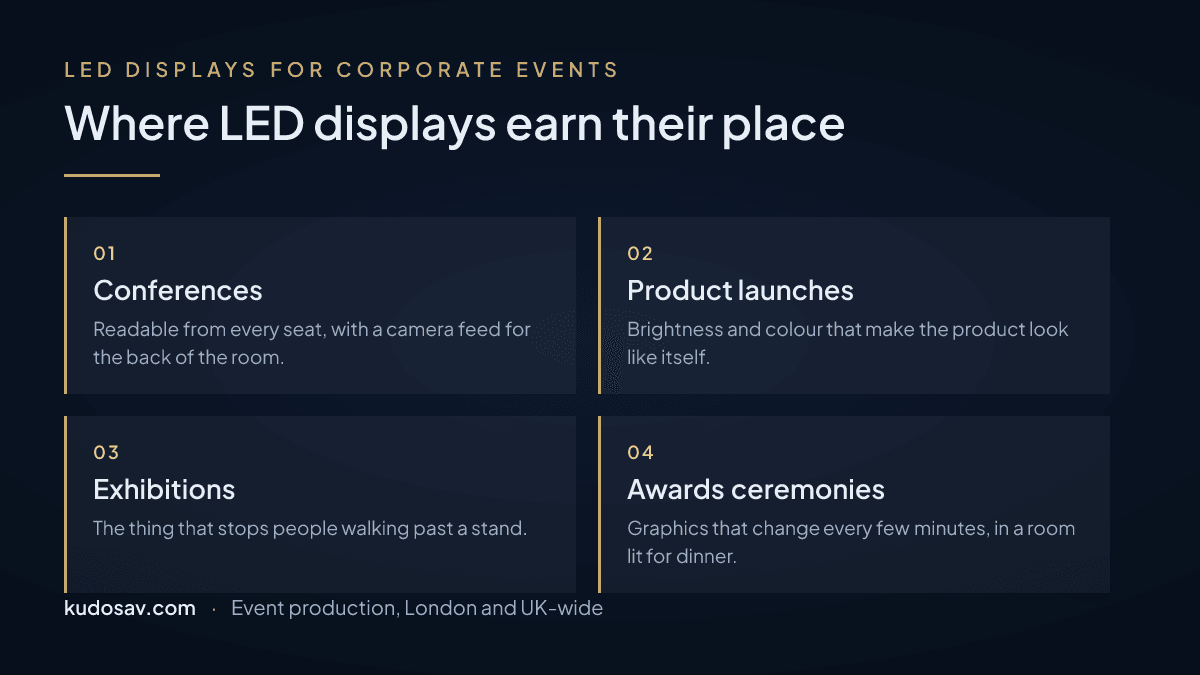
Conferences. Presentations, video and event branding stay readable from every seat, and the screen can carry a camera feed so the back of the room sees the speaker properly.
Product launches. The reveal usually depends on the picture. LED gives you the brightness and the colour to make a product look like itself rather than a washed out version of it.
Exhibitions. Stand space is bought by the square metre and lit like a supermarket. A bright screen is what stops people walking past, which is why LED dominates exhibition stands.
Awards ceremonies. Backdrops, sponsor messages and winner graphics change every few minutes, and the room is dressed and lit for a dinner rather than for a screen.
How does event design improve with LED technology?
Putting a screen on a stage is not a design. The display has to work with the lighting, the set, the sightlines and the way people move through the room, or it fights all four.
That is also the honest limit of this comparison. Projection is still the right tool in several cases: covering a very large area cheaply, throwing onto a surface that is not a screen, and projection mapping London venues where the building itself is the canvas. A listed ceiling or a facade cannot be replaced with panels, and would not want to be.
Where LED wins is consistency. Known brightness, a screen sized to the room, and content that looks the same at 9am and 9pm. Getting there means specifying pitch against viewing distance, planning power and rigging early, and building the screen into the set rather than bolting it on, which is the part a good stage design settles before anyone quotes.
What should organisers consider before choosing LED displays?
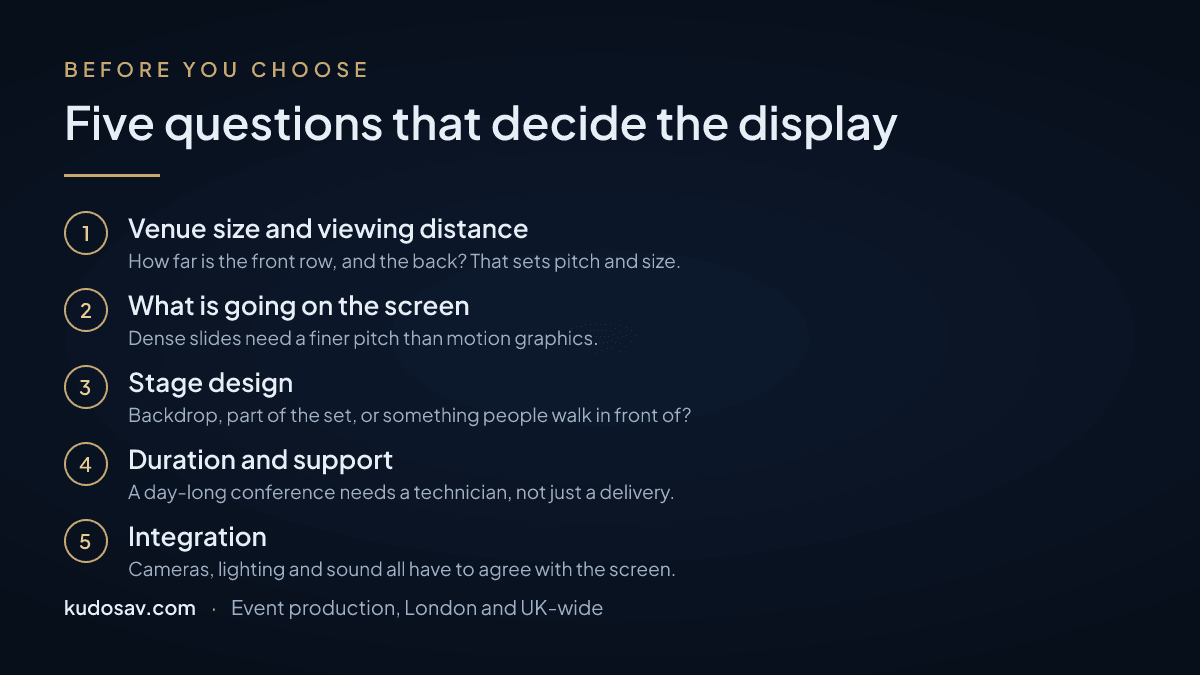
- Venue size and viewing distance. How far is the front row, and how far is the back? That sets the pitch and the size.
- What is going on the screen. Dense slides and data need a finer pitch than motion graphics do.
- Stage design. Is the screen a backdrop, part of the set, or a surface people will walk in front of?
- Duration and support. A day-long conference needs a technician on it, not just a delivery.
- Integration. Cameras, lighting and sound all have to agree with the screen, and that is easier when one team owns all four.
Answer those early and the specification writes itself. Leave them until the venue walk round and the answer is whatever fits in the time left. Our guide to what event production costs in London covers how those choices land on a budget.
Conclusion
LED has taken the conference stage because it solves the problem projection could never solve: it stays bright in a room designed for people rather than for a beam of light. It sizes to the stage, it survives the cameras, and it lets a presenter use the whole space.
None of which makes projection obsolete. Choose on the room, the content, the cameras and the budget, and there are still events where a projector is the right answer. The mistake is picking the technology before anyone has asked what the room has to do.
Planning a corporate event with LED displays?
Kudos AV designs and delivers LED displays, staging, lighting, sound and live streaming for conferences, launches, exhibitions and awards across the UK, with one production team responsible for how they work together.
Discuss your LED display requirements with our team.
Frequently asked questions
Why choose LED displays over projectors for corporate events?
LED holds its brightness in a lit room, which is where most corporate events actually happen. You can also size and shape the screen to the stage rather than the other way round, and nobody casts a shadow across it when they walk past.
Are LED displays suitable for small corporate events?
Yes. An LED wall is built from panels, so the same system scales from a two metre screen behind a lectern to a stage-width backdrop. For a small room the question is usually pixel pitch rather than size: the closer the front row sits, the finer the pitch needs to be.
What types of corporate events use LED screens?
Conferences, product launches, exhibitions, awards ceremonies and internal company meetings. Anywhere content has to stay readable with the room lights up, or the screen has to earn its place as part of the set.
Do LED displays work well for live-streamed events?
They photograph better than projection, which is the practical reason we specify them for anything filmed. Screens are set to a frame rate and shutter that matches the cameras, so the wall reads clean on the stream rather than banding or flickering.
What decides between an LED display and a projector?
Ambient light, the size of the surface you need to cover, whether the image lands on something other than a flat screen, and the budget. Projection is still the better answer for very large coverage, for mapped surfaces and when the room can be kept dark.
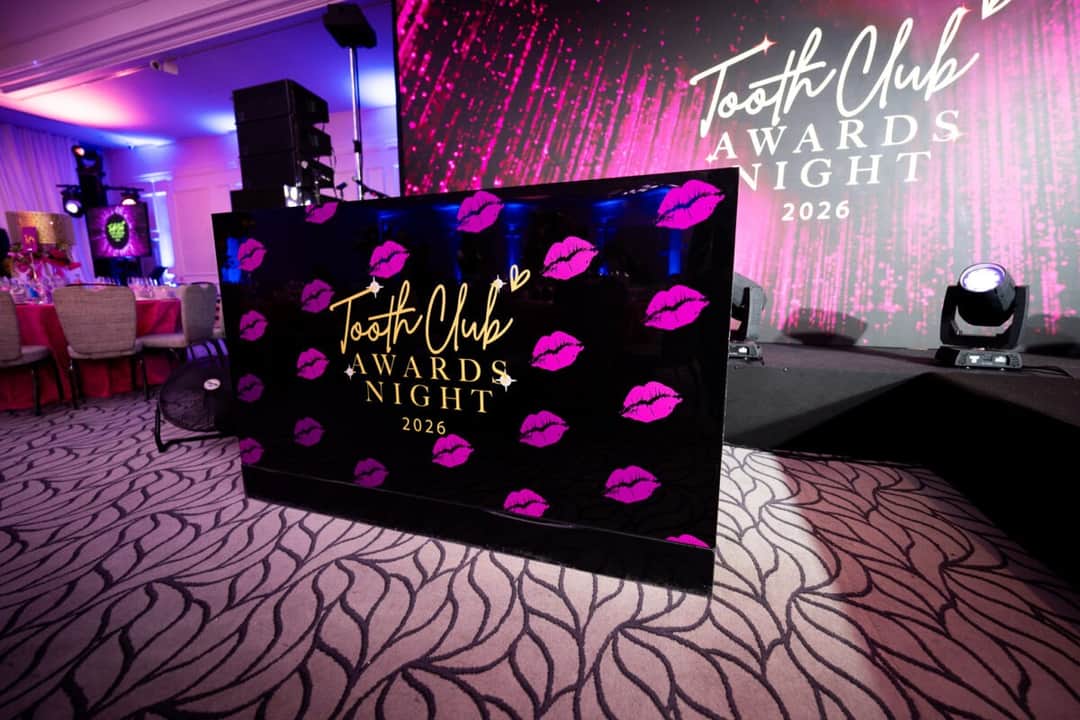
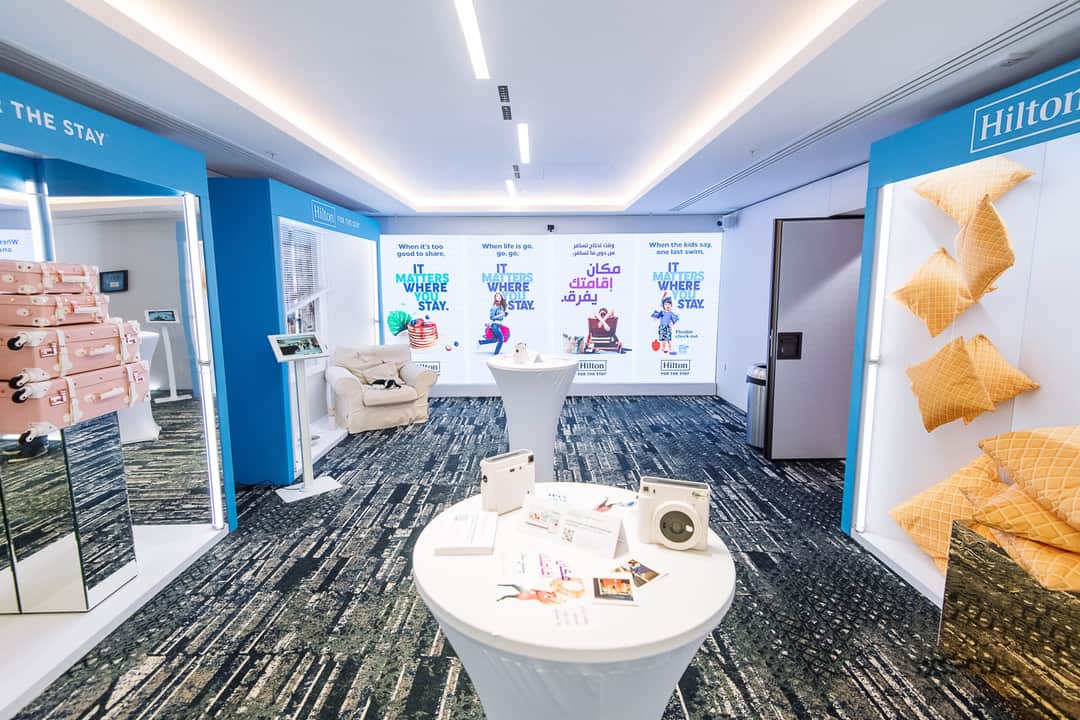
LED displays at work
 Insights & Guides
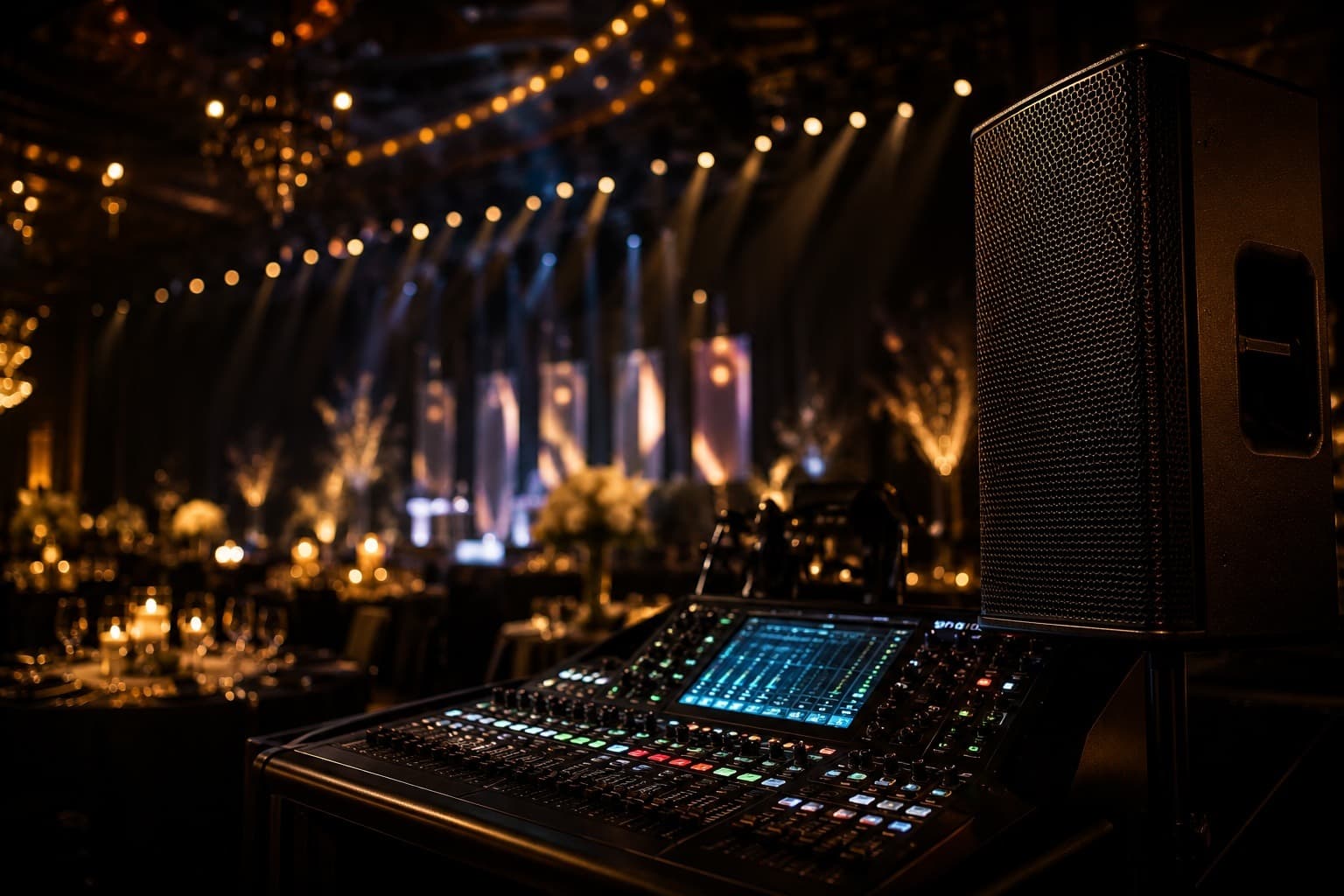
How We Calculate Audio for Any Event Space
How professional event teams assess venue acoustics, speaker coverage and delay systems to deliver clear, even sound across any room, from boardrooms to 1,000 plus capacity productions.
Read the guide Insights & Guides
How Audio Quality Impacts Audience Engagement in Live Events
How clear speech, balanced sound and reliable audio help audiences follow your message and stay engaged throughout a live event.
Read the guide Insights & Guides
Complete Guide to Planning a Hybrid Event in 2026
A practical hybrid event planning guide: how to connect in-person and virtual audiences with the right technology, stage design, streaming and engagement, so everyone feels like they are in the front row.
Read the guide